Home / Guides / How Sports Betting Works
Beginner's guide
How sports betting works: a complete beginner's guide
Everything that happens between deciding to place a bet and getting paid, explained without assuming you know any of it already.
On this page
The basic idea
Sports betting is a wager on the outcome of a sporting event, where a licensed sportsbook sets a price (the "odds") on each possible outcome and accepts money from anyone willing to bet at that price. If the outcome you bet on happens, the sportsbook pays you according to the odds you got when you placed the bet. If it doesn't, you lose your stake. That's the entire mechanism - everything else in this guide is detail on top of that one idea.
The odds themselves aren't a prediction handed down from nowhere; they're set by the sportsbook's own risk team and then adjusted based on how much money comes in on each side, so that the book can profit regardless of the outcome through a small built-in margin called the vig. Understanding that the number on the screen reflects both a probability estimate and a business margin is the single most useful mental model for a new bettor.
Opening a legal sportsbook account
To bet legally in the U.S., you open an account with a sportsbook licensed in your state. Every licensed book will ask for your full legal name, date of birth, address, and the last four digits of your Social Security number - this is a regulatory identity-verification requirement, not a red flag specific to any one operator. You'll also need to confirm your age meets your state's minimum (18 or 21 depending on the state) and be physically located in a state where the operator holds a license; the app checks your location via GPS each time you use it.
Funding the account is usually instant via debit card, PayPal, or a similar e-wallet, though options vary slightly by operator and state. We cover the differences in detail in our individual sportsbook reviews.

Reading the odds
U.S. sportsbooks display "American odds" by default: a number with a plus or minus sign next to each outcome. A minus number (like -150) tells you how much you'd need to risk to profit $100; a plus number (like +130) tells you how much you'd profit on a $100 bet. The minus side is always the favorite (more likely to happen, smaller payout); the plus side is the underdog (less likely, bigger payout). You don't need to bet in exact $100 units - the ratio applies to whatever stake you choose. Our full odds and lines guide covers decimal and fractional formats too, along with how and why lines move before kickoff.
Placing your first bet
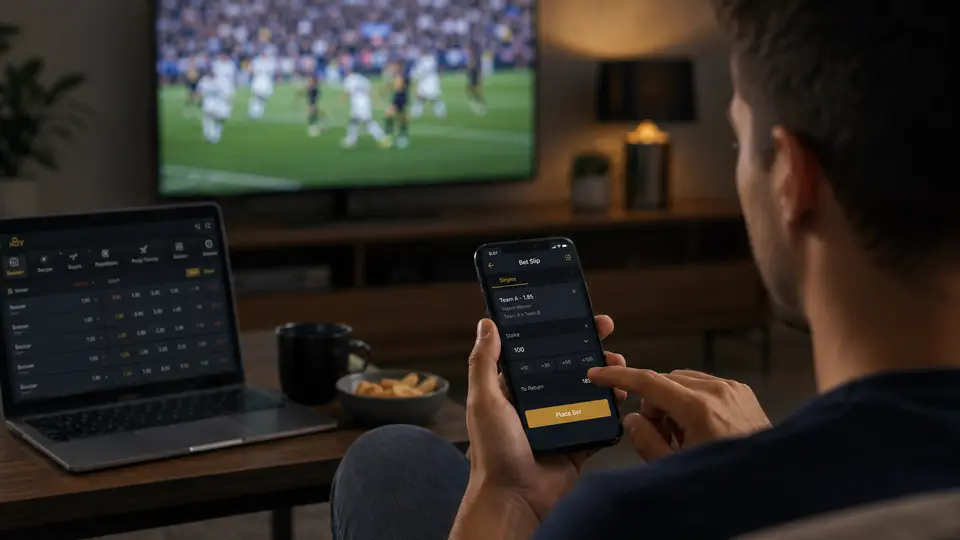
In practice, placing a bet looks like this: you browse to a game, tap the odds for the outcome you want (a team to win, a spread, a total), and it's added to your "bet slip" - a running summary of everything you're about to wager. On the bet slip, you enter your stake (how much you want to risk) and the app shows your potential payout before you confirm. Nothing is wagered until you tap the final confirm button, so browsing odds carries no risk. Our bet slip guide walks through every field you'll see, including the ones that trip up new bettors like "same game parlay" toggles and odds-format settings.
How bets settle
Once the event you bet on finishes, the sportsbook settles your bet automatically based on the official result - you don't need to do anything. Straight bets (moneyline, spread, total) typically settle within minutes of the final whistle. Bets involving player props sometimes take longer to settle, because they depend on final, league-verified statistics that can take longer to post, especially if a stat correction happens after the game (a common issue in NFL player props, for example). If a game is postponed or cancelled, sportsbooks generally void the bet and refund your stake, though exact rules vary by book and bet type.
Getting paid
Winnings are added to your sportsbook account balance automatically, immediately after the bet settles. From there, you can either use that balance to place more bets or withdraw it to a bank account, debit card, or e-wallet like PayPal, depending on what the operator supports. Withdrawal speed varies significantly by sportsbook and by payment method - this is one of the biggest real-world differences between operators, and it's why we time actual withdrawals as part of every review on this site rather than trusting marketing claims.

One thing worth knowing before your first big win: sports betting winnings are taxable income in the U.S. Sportsbooks are required to report wins above certain thresholds to the IRS via Form W-2G, but technically all net gambling winnings are taxable regardless of whether a form is issued, and you're responsible for reporting them. This isn't tax advice - talk to a tax professional if you have a winning year of any size - but it's a detail beginners are often surprised by.
Common first-bet mistakes
- Betting without a set budget. Decide what you're comfortable risking before you open the app, not while you're looking at the odds.
- Confusing "bonus bets" with cash. Promotional credit usually comes with its own rules about expiration and whether the stake is returned on a win - see our bonus guide.
- Only ever betting favorites. Favorites are priced to reflect their higher win probability, which means smaller payouts - betting only favorites isn't inherently safer in terms of long-run value, just lower-variance.
- Not comparing odds across books. The same bet is often priced slightly differently at two different sportsbooks - see our line shopping strategy guide.
Where to go next
If this was your first read on the topic, the natural next steps are our odds and lines guide to go deeper on pricing, our bet types guide to understand parlays and props, and our bankroll management guide before you place anything beyond a small first bet. When you're ready to pick a sportsbook, our ranked reviews compare the details that actually affect your results.
FAQ
Do I need to be a sports expert to bet?
No. Plenty of recreational bettors wager casually on games they enjoy watching without deep statistical analysis - just make sure you understand the bet type and are comfortable with the stake.
What's the minimum I can bet?
Most U.S. sportsbooks allow stakes as low as $0.50-$1 on most markets, making it easy to start small while you learn.
Can I cancel a bet after placing it?
Generally no, once a bet is confirmed it's locked in, though some books offer a "cash out" feature that lets you settle a bet early for an adjusted price before the event ends.
Is my money safe with a licensed sportsbook?
Licensed U.S. sportsbooks are required by state regulators to segregate customer funds from operating funds, which is a meaningful consumer protection that offshore, unlicensed sites don't offer.