Home / Insights / The Rise of Same-Game Parlays and Player Props
Industry Insights
The Rise of Same-Game Parlays and Player Props
The modern sportsbook is no longer built around only moneylines, spreads, and totals. It is increasingly built around player-level markets, parlay builders, and live interfaces designed to keep betting activity closer to the rhythm of the game itself.

From a few markets to thousands
Props and same-game parlays massively expanded what bettors can interact with before and during a game.
Books leaned into the shift
These markets are engaging, sticky, and typically more profitable for operators than standard side-and-total betting.
Live betting is part of the same evolution
Fast, in-play interfaces are now a major battleground because bettors want markets that move with the game.
On this page
- From Three Markets To Thousands: The Expansion Of What'S Bettable
- Why Bettors Shifted Toward Props And Parlays
- The Economics: Why Operators Have Leaned Into This Shift So Heavily
- Live Betting As The Next Frontier Of The Same Trend
- Risks This Shift Has Introduced, And How The Industry Has Responded
- What This Means For How A Bettor Should Think About The Product Today
If you'd looked at a U.S. sportsbook's app in 2019 and compared it to one today, the most visually obvious difference wouldn't be the logo, the color scheme, or even the odds themselves. It would be the sheer volume of same-game parlay tools and player prop markets now sitting front and center in the interface, often ahead of the traditional moneyline, spread, and total markets that used to anchor the entire product. This shift wasn't accidental, and it wasn't purely operator-driven marketing - it reflects a genuine, sustained change in how a large share of American bettors actually want to engage with a game, and it's worth understanding both why it happened and what it's meant for the broader shape of the industry.
From Three Markets To Thousands: The Expansion Of What'S Bettable
In the early years of legal U.S. sports betting, a typical NFL game listing offered a manageable handful of markets: the moneyline, the spread, the total, and perhaps a small number of team-level props. Today, a single marquee NFL game can carry many hundreds, sometimes well over a thousand, individually priced markets - passing yards for a specific quarterback, receiving yards for a specific wide receiver, first-half team totals, anytime touchdown scorer markets for a dozen or more players, and combinations of all of the above bundled into same-game parlays with correlation-adjusted pricing calculated in real time as a bettor builds their slip.
This expansion required real technical investment that didn't exist in the market's earliest years. Pricing a same-game parlay accurately - accounting for the fact that a quarterback's passing yards and his team's total points are not independent events, and shouldn't be priced as if they were - requires meaningfully more sophisticated modeling than pricing a single spread or total in isolation. The operators that have invested most heavily in this specific capability, correlation-aware same-game parlay pricing, have built a genuine, defensible product differentiator that's harder for a newer or smaller competitor to replicate quickly than simply matching a competitor's headline odds on a standard market.
Why Bettors Shifted Toward Props And Parlays
The demand side of this shift is at least as important as the supply side, and it traces back to a few converging factors. The most straightforward is a preference many recreational bettors have for combining a smaller stake with a larger potential payout, even at meaningfully reduced win probability - the same underlying appeal that has always made lottery-style bets popular, now applied within a sports context that offers far more control and specificity than a lottery ticket does. A bettor building a same-game parlay isn't just accepting long odds passively; they're actively constructing a specific, detailed opinion about how a game will unfold, leg by leg, which is a fundamentally more engaging and personalized activity than simply picking a side on a single spread.
Player props specifically have benefited from a second, related trend: a broader generational shift, visible well beyond sports betting, toward individual athlete attention over pure team-outcome attention. Fantasy sports - both traditional season-long leagues and the explosively popular daily fantasy sports format that DraftKings and FanDuel themselves were built on before either company entered licensed sports betting - trained an entire generation of sports fans to think about games in terms of individual statistical performance rather than only final scores. When those same fans moved into legal sports betting, player props offered a natural, familiar extension of exactly the kind of engagement they were already primed for, which is part of why DraftKings' and FanDuel's deep roots in daily fantasy gave both companies a meaningful head start in prop market sophistication relative to competitors entering from a pure casino or media background.
Props and same-game parlays massively expanded what bettors can interact with before and during a game.
The Economics: Why Operators Have Leaned Into This Shift So Heavily
From an operator's perspective, the shift toward parlays and props has a clear, favorable economic logic that goes beyond simply meeting existing customer demand. As covered in more detail in our companion piece on sportsbook promotion economics, a multi-leg parlay carries a meaningfully higher effective house edge, as a percentage of handle, than the same legs bet as separate straight wagers - a direct, well-understood consequence of the sportsbook's standard per-leg margin compounding across every additional leg in the combination. Player props, similarly, tend to carry wider pricing margins on average than the most heavily bet, most closely scrutinized mainstream markets like NFL point spreads, in part because props are individually lower-volume and harder for the broader betting public to collectively price-check against a clear consensus the way a marquee spread gets checked.
This creates a genuine, if rarely stated outright, alignment between what many recreational bettors find most engaging and what's most economically favorable for the operator to promote heavily - same-game parlays and player props aren't merely offered because bettors want them; they're actively surfaced, marketed, and made easier to build than a simple straight bet in many app interfaces specifically because the underlying economics favor the operator more on these bet types than on standard markets. This isn't a hidden conspiracy - it's a straightforward, publicly understood feature of how betting margins work, discussed openly within the industry itself - but it's a genuinely useful piece of context for a bettor deciding how much of their overall activity to concentrate in these bet types versus more traditional straight bets.
Live Betting As The Next Frontier Of The Same Trend
The same underlying appetite for granular, real-time engagement that's driven the rise of props and parlays has extended naturally into live, in-play betting, which has grown from a secondary feature into a primary use case for a meaningful and growing share of bettors, particularly during high-profile events. Live betting offers an even more compressed, moment-to-moment version of the same core appeal - a bettor isn't just picking a side before the game starts, they're reacting in real time to specific in-game developments, placing new bets as the situation evolves. This has pushed genuine technical investment into reducing the latency between an in-game event and an updated live price, and into designing live-betting interfaces dense enough to support fast-moving markets without becoming unusable for a less experienced bettor - a real design challenge that different operators have solved with noticeably different degrees of success, reflected in the meaningful gaps in live-betting speed and market depth our individual sportsbook reviews document.
Risks This Shift Has Introduced, And How The Industry Has Responded
The rapid growth of same-game parlays and player props hasn't been without genuine downside worth naming directly. The combination of higher effective house edge and the psychological appeal of a large potential payout for a small stake creates real risk of bettors underestimating how unlikely a given multi-leg combination actually is to hit, a pattern covered in detail in our dedicated parlay strategy guide. Some sportsbooks have also faced scrutiny over marketing practices that emphasize potential payout size prominently while presenting the underlying win probability far less visibly - a criticism that has, in a genuinely positive development, pushed several operators toward clearer in-app disclosure of a parlay's combined implied probability alongside its potential payout, not merely the payout figure alone.
Player prop markets specifically have also introduced a newer category of integrity concern that didn't exist to the same degree under the older, narrower slate of mainstream markets: the sheer volume and specificity of individual player prop markets available creates a theoretically larger surface area for concerns about insider information or match-fixing at the individual-player level, compared to a smaller number of closely monitored, heavily bet mainstream markets. This has led to increased investment from both operators and professional sports leagues in integrity monitoring specifically focused on unusual betting patterns in prop markets, an area of the industry's infrastructure that's grown substantially, if largely invisibly to the average bettor, alongside the growth of the prop markets themselves.
What This Means For How A Bettor Should Think About The Product Today
None of this history is an argument against betting parlays or props - for many bettors, the specific, granular engagement they offer is a genuine, legitimate part of what makes sports betting enjoyable as a hobby, and there's nothing wrong with that being the primary way you choose to engage with it. The more useful takeaway is contextual: understanding that same-game parlays and player props carry structurally wider margins than standard markets on average is directly useful information for deciding how to allocate a betting budget across bet types, exactly the kind of decision our bankroll management and parlay strategy guides address in practical terms. And understanding that this entire category of product exists, in its current heavily-promoted form, partly because it's more profitable for operators on a per-dollar-wagered basis than standard markets is the kind of structural context that turns "why does the app push same-game parlays so hard" from a vague observation into a clearly understood, entirely rational piece of industry economics - knowledge that puts you in a better position to decide, deliberately, how much of your own betting activity you want to allocate there.
More from Insights
Continue with the other original industry articles in the series.

The State of the U.S. Sports Betting Market in 2026
Eight years after PASPA fell, the American market is no longer a simple legalization story. It is a state-by-state ecosystem shaped by tax p...
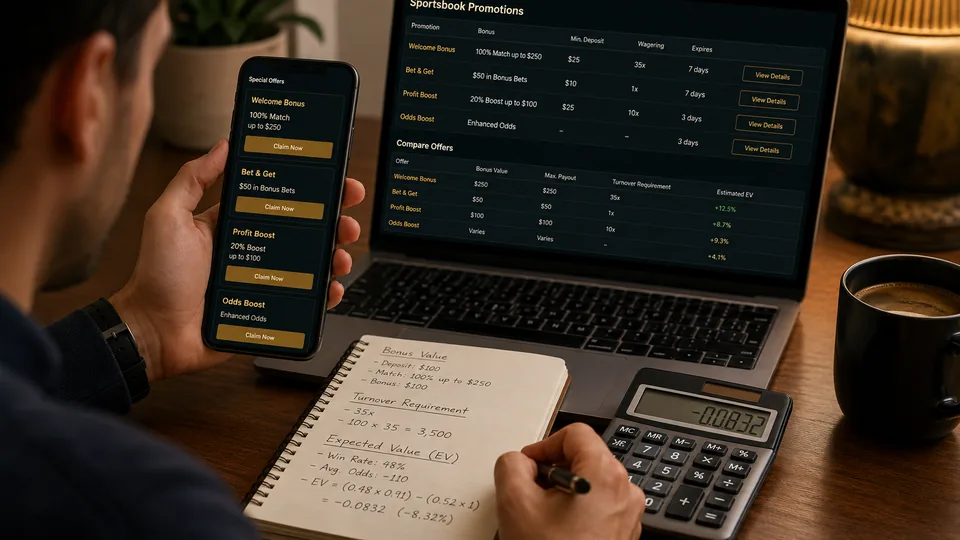
The Economics of Sportsbook Promotions
Promo offers are not random generosity. They are acquisition tools shaped by customer lifetime value, competitive pressure, risk management,...

Media, Merch, and Margin: Betting Beyond Native Sportsbooks
One of the clearest strategic shifts in betting has been convergence: sportsbooks borrowing trust, attention, and habits from media companie...

How Responsible Gambling Tools Became a Core Part of the Product
Responsible gambling tools used to feel like quiet compliance features buried in account settings. Over time, regulation, behavioral data, a...